
Dear Fellow Wanderers,
October has arrived at Eliguk Lake, which means nearly every conversation around here now contains the words, “before it freezes.” There is always a point in autumn when the season stops feeling leisurely. September still leaves room for optimism, but October starts looking at its watch. Suddenly every unfinished job has acquired a deadline, and the weather appears to have appointed itself foreman.
The Last of the Garden
The greenhouse is hanging on, although it is beginning to look less like a greenhouse and more like the last carriage on a departing train. A few tomatoes are still trying to colour before the cold catches them. The carrots have finished their business underground, and some have been left to flower and go to seed. Our heirloom lettuces have done the same, stretching themselves into tall, improbable plants that bear almost no resemblance to the tidy leaves we were eating a few months ago.
At first glance, a garden going to seed can look neglected, but to me it looks like next summer. Those dry flower heads are carrying another season inside them, so we collect the seed, dry it, label it and put it away for spring. There is something deeply satisfying about planting seed from a plant that has already proved itself here. It survived our short growing season, cool nights, strange weather, my occasional neglect and whatever insect decided it had discovered fine dining. If a plant manages all that and still produces seed, I figure it has earned descendants.
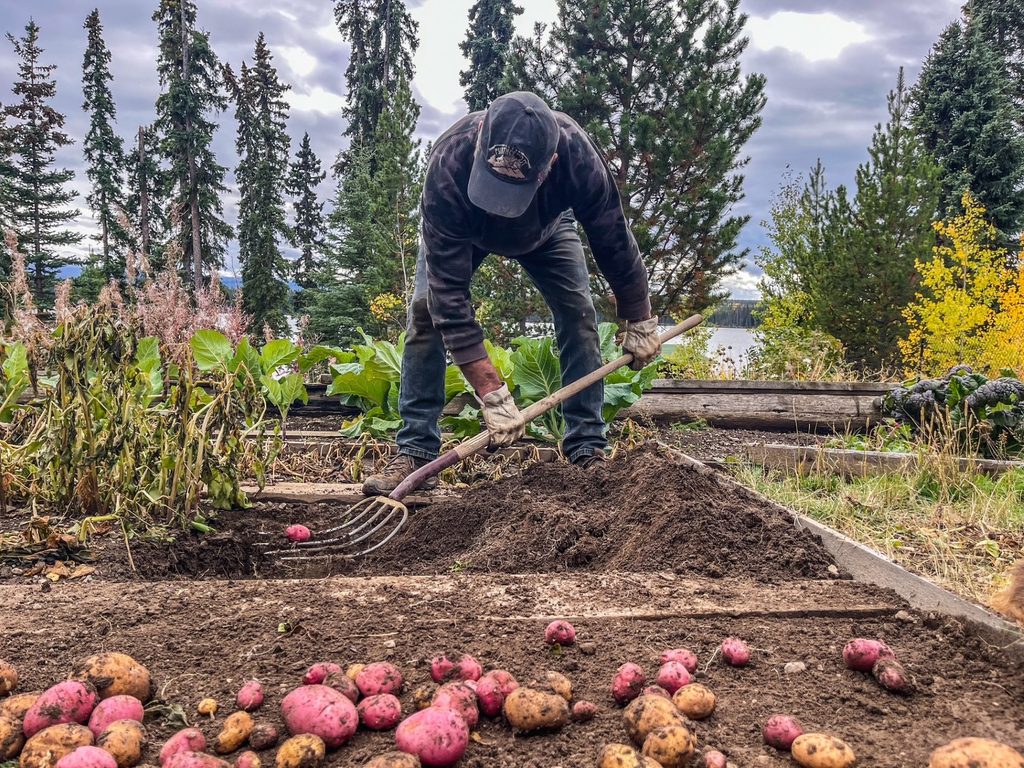
We also managed to get all the potatoes dug before the ground decides to become a solid object, which always feels like a small victory. There is something especially satisfying about turning over cold autumn soil and finding food underneath it, particularly when the crop looks more like a paint box than a sack of ordinary spuds. We grow five different varieties, including deep purple heirlooms and gourmet red fingerlings, so ours are allowed a little vanity. Some are perfectly round, while others are knobby; some are jewel-coloured, and very few look like anything destined for a standard grocery-store bin. They spend the summer quietly multiplying beneath the soil while the garden above them takes all the credit. Then autumn comes, the fork goes in, and suddenly supper starts appearing in purple, red, gold, and cream.
We had been watching the temperatures closely because there is a fairly narrow window between “we should probably dig those soon” and “bring a pickaxe.” This year, we won. The potatoes are out, sorted and stored, which is one more job crossed off a list that somehow becomes longer every time we cross something off.
None of this is particularly new, of course. Saving seed, digging root crops and storing food were simply part of life for generations before us. People kept what performed well, traded varieties with neighbours and gradually developed plants suited to the places where they lived. The garden was not separate from the pantry. It was part of the household economy, and October was when much of that account came due.
For pioneers, homesteaders, and farming families, autumn was less about admiring pumpkins and more about making sure everyone survived until spring. Root vegetables were dug and stored, beans dried, apples packed away, meat smoked or preserved, firewood brought under cover, chimneys cleaned, clothing mended, and tools repaired and sharpened. Nothing useful was discarded lightly. Bones became broth, fat was rendered, ash had a purpose, worn fabric became patches or quilts, food scraps fed livestock, and wood scraps went into the stove. People did not call it sustainable living. They simply called it living.
There is a tendency now to romanticize that kind of existence, usually from the comfortable side of a thermostat. The reality was considerably less poetic. Winter did not care whether anyone felt prepared for it, and if something needed doing before the ground froze, it got done. That part of October remains very recognizable around here.
September Left a Few Loose Ends
September left a few loose ends dragging behind it, which seems fair considering how much we asked of the month. The secret we had been sitting on finally escaped, Mountain Men: Wild North is no longer something we have to pretend not to know about, and “Some of Forever” made its way out into the world on our 30th anniversary. For a month that usually marks the quiet slide toward winter, September was remarkably incapable of keeping anything quiet.
Last month I wrote that September seemed to know something we didn’t. Apparently it did, because October now seems to have found the entire file and is reading it aloud while tapping its watch. One of those unfinished pieces was our anniversary duck hunt, which had sounded like a perfectly good plan until the weather was invited to participate.
A windstorm arrived with all the tact of an uninvited lost relative, and turned the lake into something better suited to testing survival equipment than celebrating thirty years of marriage out under the canopy of snapping trees. The ducks therefore retained temporary possession of themselves. One of the advantages of living where we do is that we really don’t have to schedule a duck hunt. The lake is still here, the ducks are still here, and we are still here – so theoretically we can simply go another day.
Theoretically is doing quite a bit of work in that sentence. In practice, people have developed an impressive ability to appear unexpectedly at the exact moment we think we might sneak away and do something for ourselves. Nothing encourages spontaneity quite like seeing a floatplane circle the lake when you already have boots on and a shotgun by the door.
We did manage to put a few grouse in the freezer, so the outing was not a complete failure. The ducks have merely been granted an extension. Any day now, there may be two reasonably respectable adults crouched along the shoreline making questionable quacking noises and hoping nobody flies in. Around here, that qualifies as an exciting afternoon off.
Our 30th anniversary ended up being quieter than planned, thanks to the windstorm putting an abrupt end to the duck-hunt portion of the day. So instead of duck à l’orange, duck confit, cherry-glazed breast, or anything else requiring a French accent and a linen napkin, we had a romantic dinner back at the cabin with Italian-style roasted pork belly, Greek potatoes, and salad. It was rich, uncomplicated, and very us – which, after thirty years, is probably the point.
We did release “Some of Forever” on September 28, which felt like a better marker of thirty years together than trying to manufacture something grand for the occasion. The song was never really meant to be about one anniversary anyway. It is about the far less glamorous part of a long relationship, the repeated decision that, after everything life has dragged through the doorway, you would still choose the same person standing on the other side of it. That feels considerably more accurate to us.
So October begins with several things September promised now sitting in the rear-view mirror, while winter is becoming increasingly visible through the windshield. The song is out, the secret is out, the ducks are still out, and nearly everything else around here is being brought in.
Before It Freezes
Arön seems to start a different project every morning, and I am beginning to suspect there may actually be several versions of him working simultaneously. The boats are coming out of the water, outboard motors are being serviced and moved into storage, water lines are being drained, fire hoses are being rolled, and the pumps, sprinklers, barrels and other equipment that stood ready through fire season are finally being dismantled.
For months we prepare to put water everywhere. Then autumn arrives and we spend several weeks trying desperately to get water out of everything. That, in one sentence, is seasonal life in the bush.
Our domestic water system is also beginning its annual retreat. For those who are new to our story, Eliguk sits on volcanic ground and bedrock, so burying our water lines several feet beneath the frost line is not a practical option. In many places, digging several feet would require considerably more than a shovel and a positive attitude – (besides we are on a plot of land that doesn’t allow us to dig.) Our water lines therefore run above ground, which is perfectly civilized in July and slightly less impressive by October.
At the moment, showers are generally scheduled for sunny afternoons. When we have enough solar power and the temperature is cooperating, we pump water into the tower, refill the system and briefly enjoy the extravagant modern luxury of turning a tap and having water come out. Then, before the evening temperature drops, everything has to be drained again. There is something uniquely motivating about showering while mentally calculating how many hours remain before the plumbing becomes an ice sculpture.
Soon even that arrangement will end. Once winter settles in properly, our household water will once again come from the lake by bucket. I know this happens every year and I remain opposed to it. Running water may be one of mankind’s greater achievements, right up there with antibiotics, written language and not carrying forty pounds of water uphill before making coffee.
October is also when we begin putting the resort to bed in less obvious ways. Cabins need to be aired, checked, and closed up properly. Bedding gets sorted, food stores are reorganized, anything vulnerable to mice gets moved into safer quarters, screens and outdoor furniture come in, pathways are cleared, woodpiles are topped up, and anything we may need after the first serious snowfall has to be put somewhere we can still reach it. Anything that can be ruined by freezing also migrates into the warm cabin – glues, solvents, alkyd paints, sealants, and all the other workshop odds and ends that are perfectly happy in summer and suddenly become liabilities once the temperature drops. It is also the month for checking doors, roofs, chimneys, batteries, generators, and all the small things that are easy to ignore in July and extremely inconvenient to discover in January. By the time we are done, the whole place feels as though it has drawn its shoulders up against the weather.
October also has a way of exposing every little thing we ignored while summer was busy being summer. A loose hinge, a stubborn latch, a cracked handle, a stack of something left in exactly the wrong place – all suddenly become important once snow is close enough to start making decisions for us. There is a brief window when the ground is still workable, daylight is still useful and everything outdoors can still be moved without first chiselling it free.
That is what much of October really feels like here. Not one dramatic job, but a hundred small corrections made before winter has the chance to turn them into larger ones. The season becomes a kind of inventory – what needs fixing, what needs moving, what needs storing, what needs protecting, and what we are willing to leave exactly where it is and deal with again in May.
For all the scramble of October, there is another side to the month that makes it difficult to resent. The light becomes extraordinary. The sun rises later and disappears earlier, but seems determined to compensate for its shortened workday by becoming theatrical about both entrances and exits.
Some mornings the entire lake changes colour before breakfast. The sky moves through orange, copper, rose and violet while the mountains flatten into dark silhouettes along the horizon, and by evening the performance begins again from the opposite direction. It regularly stops us in the middle of whatever we are doing. A tool gets put down, a wheelbarrow stops halfway across the yard, or one of us comes through the door and says, “You need to see this.”
There are times when the sky over Eliguk becomes so excessive that ignoring it would feel rude. We stand there for a few minutes while daylight empties itself across the lake, and whatever seemed desperately important moments earlier can wait. Photographs never quite get it right, although I continue taking them anyway.
A Different Kind of October
This October also carries something very different for us. Mountain Men: Wild North begins its new season in the United States on October 7, followed by the Canadian premiere on October 8, and yes, we are nervous. In fact, I suspect we are more nervous about seeing it than we ever were about filming it.
During production, we were simply doing what we normally do – with a little more seriousness, other than our hand-holding, happy-go-lucky selves. There was work to finish, equipment to move, things to build, problems to solve, and a resort to keep functioning. A camera crew happened to be standing nearby. Watching the finished program is different because that part no longer belongs to us.
We know what happened here, what was filmed, how many hours went into certain projects, and what was happening outside the frame. What we do not know is how those hours have been reduced, rearranged, and stitched together into television. That is the strange bargain of reality TV: you supply the reality, and somebody else supplies the television. All we could do was keep living our life while the cameras documented it – albeit we had to remain serious at all times, and refrain from being our happy-go-lucky, hand-holding selves while running the resort, working through fire season, building, repairing, and dealing with whatever the wilderness put in front of us on those days. That was the story they had to work with.
We filmed a number of stories for this season. We are not in the first episode, so nobody needs to spend October 7 or 8 squinting at the screen, wondering whether they missed us behind a tree. We are introduced in Episode Two, but we are more prominent in the second half of this season’s show. From there, we will see the finished episodes at essentially the same time everyone else does, which is a mildly terrifying thought.
Still, I hope people recognize something genuine in what they see. The image of the “mountain man” has become so stereotyped that people often picture a solitary trapper permanently disappearing into the bush, but that was never the whole story. Many trappers married, raised families, built cabins, kept gardens, cut hay, preserved food, tended animals, and settled into the practical work of homesteading when they were not on the trap-line, or after they retired from it altogether. Wilderness life has always been broader than buckskins and beaver pelts. This is not a set that disappears when filming ends. When the crew leaves, the wood still needs splitting, the water still needs hauling, equipment still needs fixing, food still needs growing, and winter still arrives whether anyone has called “cut” or not. The television part is temporary. The work is not.
Rainy Days Mean Podcast Days
While all of that is beginning, we are also turning our attention back toward the Furthermost Outpost Podcast – the launch of Season 2. Rainy days are becoming recording days whenever we can manage it, and the new season launches in November.
There will certainly be conversations about Mountain Men, including some of the things viewers will never see on screen, but we also want to talk about the year we have just lived through, the realities of running a remote property, the decisions we make out here and a few subjects likely to produce considerably more discussion than agreement. Those are usually the interesting ones. There are several interviews to schedule this Winter, so there’s a great variety coming your way.
I already have notes everywhere. Now I simply need the weather to trap us indoors long enough to turn them into episodes.
October on the Hinge
There is always something slightly melancholy about October at Eliguk. Not sad exactly, but final. The floatplanes become fewer, boats disappear from the shoreline, cabins grow quiet and migrating birds pass through in groups, apparently better organized than we are. Snow begins appearing higher up in the mountains, and ice starts forming on top of the chicken’s water over night.
The wilderness slowly begins closing doors. Eventually there will be a morning when the lake stops moving altogether, and that moment changes everything. Our seasons are not really measured by dates on a calendar so much as events on the land: ice off, green-up, fire season, berry season, harvest, freeze-up and snow. Months later, the first dark strip of open water will appear again along the shoreline and the entire machine will begin turning in the other direction.
October sits directly on that hinge, with one side still clinging to summer and the other already leaning hard toward winter. The last of the garden is coming in, the ducks have been granted a temporary reprieve, the sky keeps stopping us in our tracks, and somewhere between all of it we are recording a new podcast season and waiting to see what television made of the year we actually lived. It is a strange month to call quiet, but then October at Eliguk has never been very good at minding its own business.
This frantic stretch between seasons is part of the life too. It is not always the polished part, and certainly not always the photogenic part, but it may be one of the more honest parts.
If you have not signed up for Join the Journey, make sure you do. That is where we will share upcoming stories, podcast news, behind-the-scenes pieces and the things happening beyond what makes it onto social media or television. If you want to see what we are doing from one day to the next, follow Furthermost Outpost on Facebook, because that is usually where the evidence appears while it is happening.
Until the next letter from the wilderness,
Jennifer
Furthermost Outpost

Be First to Comment